What Happens After Marking? Closing Learning Gaps Without Increasing Teacher Workload
Marking is rarely the end of the work.
In many UK schools, marking is one of the most time-consuming parts of teacher workload, but what happens after marking often determines whether learning gaps actually close.
You set the task.
Pupils complete it.
You read through responses.
You identify what went well and what didn’t.
But then comes the harder question:
What happens next?
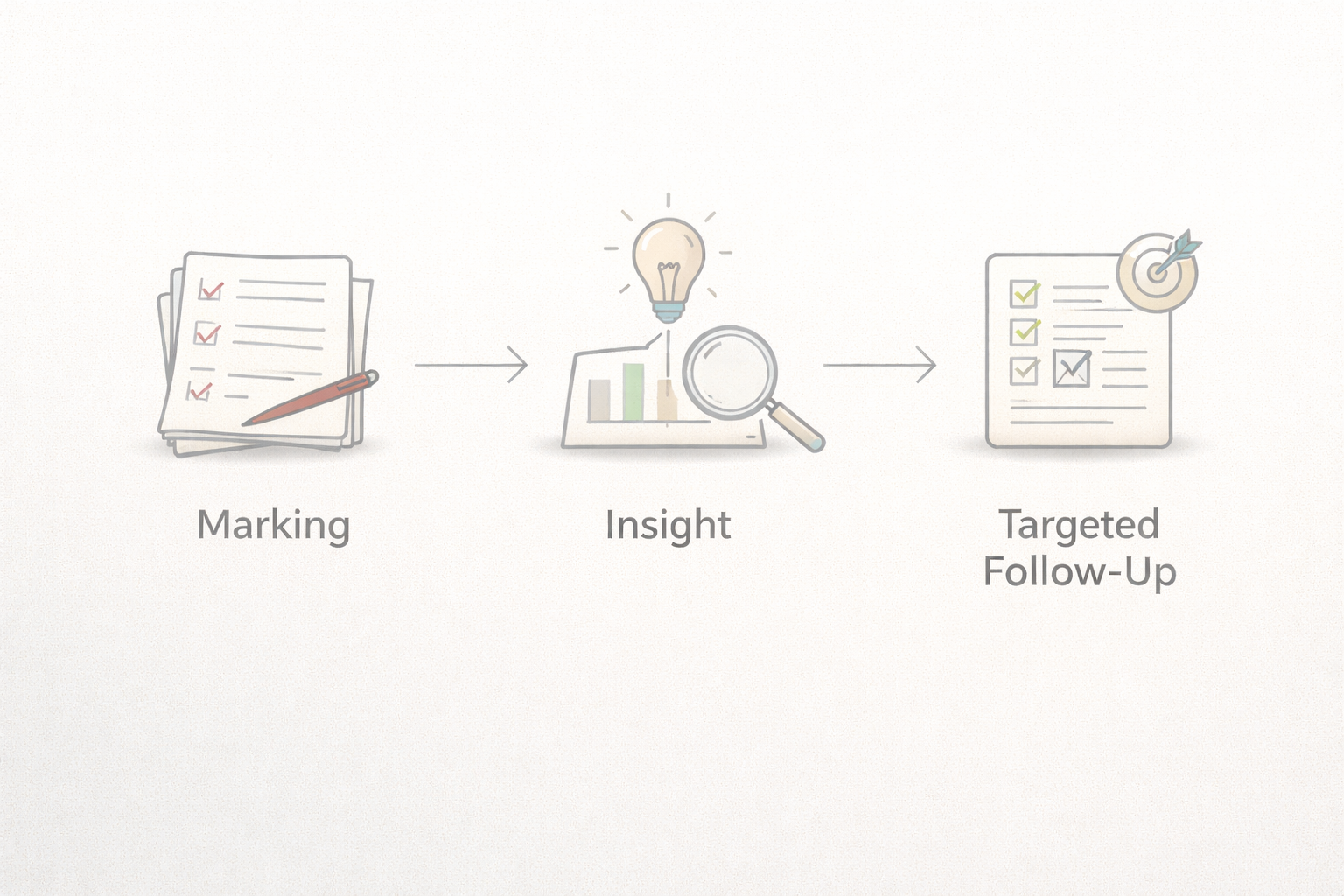
The Illusion That Marking Equals Progress
There’s a quiet assumption in education that once work is marked, learning has moved forward.
Sometimes it has.
But often, marking reveals something more complicated:
A misconception repeated across several pupils
A concept partially understood but not secure
A pattern of errors that isn’t obvious at first glance
Marking surfaces the gaps.
It doesn’t automatically close them.
And closing them takes time; time that’s already stretched.
Without structured follow-up, teacher workload increases, as gaps resurface later, requiring reteaching, repeated explanations, and additional planning.
The Real Work Starts After the Red Pen
After marking, teachers usually have to decide:
Do I reteach this whole concept?
Do I adjust tomorrow’s lesson?
Do I provide targeted support?
Or do we move on and hope it settles?
None of these decisions are simple.
They require professional judgement.
They require context.
They require energy.
And when the term is busy — which it almost always is — follow-up can become inconsistent, not because teachers don’t care, but because systems don’t support that stage well.
Why Many AI Tools Stop Too Early
A growing number of tools now help with:
Creating assignments
Drafting feedback
Speeding up marking
That support can be valuable.
But most AI tools in education focus on speeding up marking, and fewer focus on what comes next.
They help produce work faster.
They don’t necessarily help teachers respond to what that work reveals.
And that’s where learning either deepens or quietly stalls.
Marking Should Lead Somewhere
If marking is to make a difference, it needs to connect to action.
Not wholesale reinvention.
Not doubling workload.
Just clear, manageable follow-up.
For example:
Identifying the most common misconception in a class
Creating a short retrieval task focused on that gap
Offering targeted reinforcement instead of full reteaching
Small adjustments.
Informed decisions.
Sustainable responses.
That’s what moves learning forward.
This is where AI can support teachers without replacing professional judgement.
AI can help organise patterns.
It can highlight trends.
It can reduce some of the administrative load.
But deciding how to respond always belongs to the teacher.
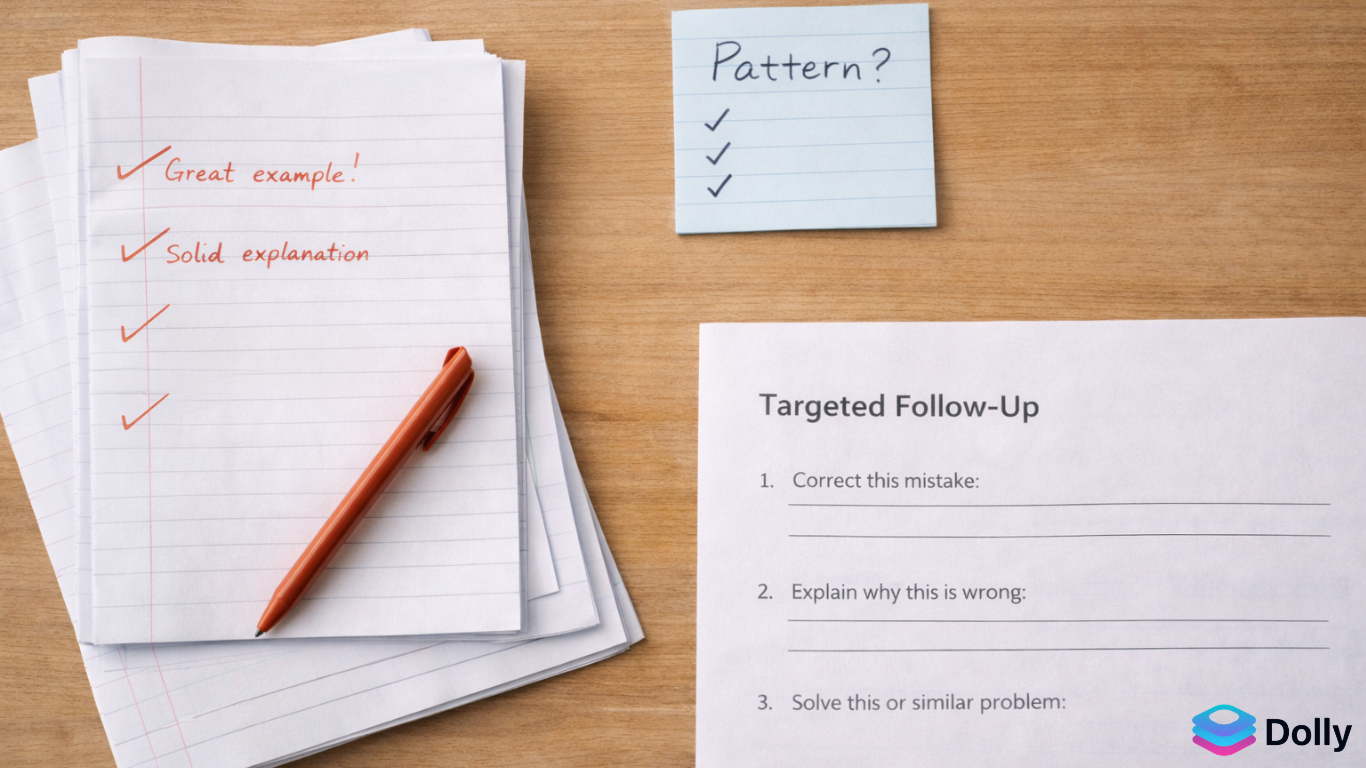
A More Connected Approach
Dolly is still in its early stage.
But it’s being built around this exact moment. The one after marking.
Right now, we’re focused on supporting teachers with:
Structured assignment creation
Simple insight tools that highlight patterns
Follow-up supports designed to make closing gaps more manageable
Not to replace professional judgement.
Not to automate decisions.
But to make it easier to see what needs attention and respond without starting from scratch.
When follow-up is clearer and more focused, teacher workload becomes more sustainable.
Why This Matters in March
By early March, the term is well underway.
Assessment pressure builds.
Curriculum pacing tightens.
Energy isn’t always at its peak.
This is when follow-up can feel heavy.
And this is when having a clearer view of where learning broke down can reduce guesswork and reduce unnecessary re-planning.
A Final Thought
Marking is not the finish line.
It’s a signal.
The real impact comes from what happens after, the decisions, the adjustments, the targeted reinforcement.
AI in Education can help support that process.
But the judgement, care, and context always belongs to teachers.
Dolly’s role is simple:
Support the follow-up.
Protect teacher energy.
Keep the learning loop connected.
If you’re interested in exploring a more connected approach to assignments, insight, and follow-up in UK classrooms, you can learn more at → godolly.ai