Where AI Actually Helps Teachers(And Where It Should Stay Out of the Way)
AI is everywhere in education right now.
Lesson planning. Marking. Reports. Emails. Behaviour tracking. Data analysis.
Depending on who you ask, it’s either going to save teaching or ruin it.
But for most teachers, the question isn’t whether AI is good or bad.
It’s much simpler: Which parts of teaching need support, and which should always stay human?
Because teaching is not a single task. It’s a mix of cognitive work, emotional labour, professional judgement, and human connection. And AI doesn’t belong equally in all of those spaces.
Where AI Actually Helps Teachers
AI earns its place when it reduces load, not when it replaces thinking.
The most useful applications of AI in education tend to fall into one category:
tasks that are necessary, repetitive, and mentally draining but not human at their core.
1. Planning frameworks and first drafts
Planning is essential. Reinventing everything from scratch every time isn’t.
AI can be genuinely helpful when it:
Generates lesson structures or outlines
Suggests objectives aligned to curriculum standards
Offers starting points that teachers can adapt and refine
This is about momentum, not automation.
Teachers still decide what and how to teach. AI simply helps them start faster.
This gap is exactly where Dolly was built to sit.
Not to plan for teachers, but to remove the blank-page fatigue that often turns planning into an evening-long task, especially in UK classrooms where curriculum alignment matters.
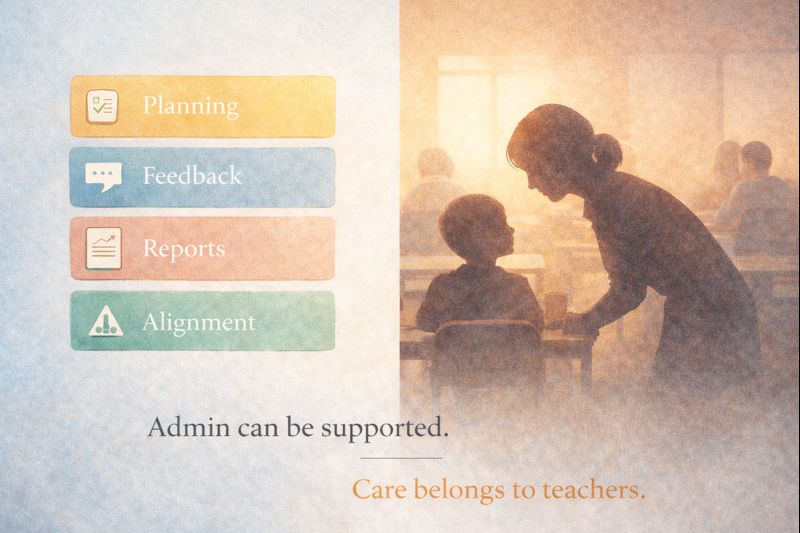
2. Drafting admin-heavy content
Some parts of teaching are important but exhausting.
Things like:
Report comments
Feedback phrasing
Progress summaries
Alignment checks
These tasks don’t need a fresh burst of creativity every time. They need clarity, consistency, and time.
AI works best here as a drafting assistant, producing a base that teachers can edit, personalise, and approve. The judgment always stays human. The time drain doesn’t have to.
3. Supporting low-energy moments
This is the part that rarely gets talked about.
Teachers don’t only work on high-energy, inspired days.
They work when they’re tired. When it’s week seven. When it’s January. When they’re carrying more than usual.
On those days, AI can quietly:
Reduce cognitive load
Provide structure when mental energy is low
Help teachers meet expectations without burning out
Tools like Dolly are most useful here. Not as productivity boosters, but as energy protectors.
Where AI Should Stay Out of the Way
Just because AI can do something doesn’t mean it should.
There are parts of teaching where AI doesn’t belong and shouldn’t be forced in.
1. Professional judgement
Teaching is full of nuance:
Reading a class’s mood
Knowing when to slow down
Deciding when to push or pause
These decisions come from experience, context, and human insight. No system can replicate that.
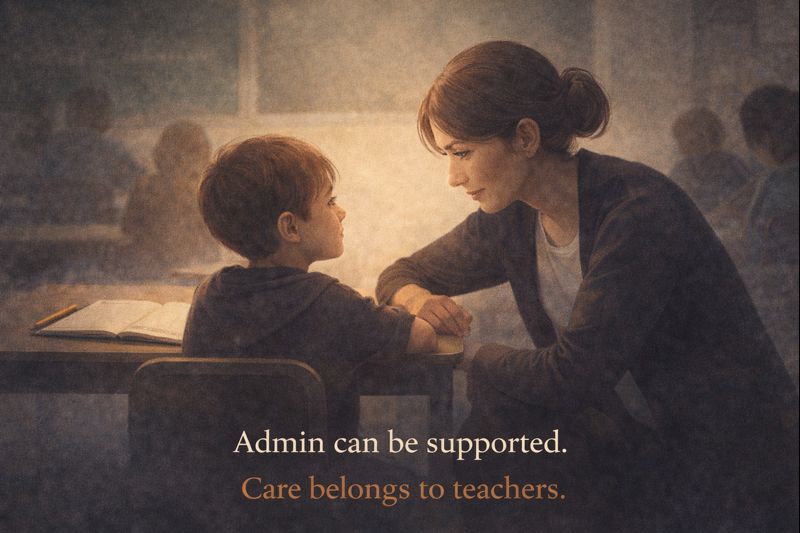
2. Relationships and care
The most impactful moments in teaching often look small:
A quiet check-in
A reassuring word
Noticing when a pupil isn’t themselves
These are not “inefficient” moments. They are the work.
AI should never replace connection. They should only protect the time and energy teachers need to sustain it.
3. Creativity and meaning-making
Great lessons don’t come from templates alone.
They come from curiosity, humour, responsiveness, and lived experience.
AI can support the scaffolding.
The meaning still belongs to the teacher.
A Teacher-First Approach to AI
The problem isn’t AI itself.
It’s AI that’s designed without teachers in mind.
When AI is built around speed, scale, or surveillance, it adds pressure.
When it’s built around sustainability and real classroom, it can quietly help teachers stay in the profession longer.
At Dolly, that distinction is intentional.
Built alongside UK teachers, Dolly uses AI to support:
Planning
Marking
Reports
Curriculum alignment
Not to dictate pace or pedagogy but to reduce the background admin noise that drains time and energy.
The principle is simple:
Admin can be supported.
Care, judgement, and connection belong to teachers.
The Right Question to Ask About AI in Teaching
The question isn’t: “Can AI do this?”
It’s: “Does this help teachers teach or does it ask more of them?”
When AI:
Reduces unnecessary effort
Respects professional autonomy
Protects energy for human work
It belongs.
When it:
Adds pressure
Replaces judgement
Demands constant engagement
It doesn’t.
Teaching doesn’t need more tools shouting for attention.
It needs quiet support in the background, especially in a system already stretched thin.
A final thought
AI won’t fix education.
Teachers will.
The role of technology is not to replace that work, but to make it possible to keep doing it, sustainably.
If you’re looking for a way to reduce planning, marking, and admin pressure, especially in low-energy moments, Dolly is here to support you. Quietly, flexibly, and built around the reality of UK classrooms.
👉 Explore how Dolly supports teachers: godolly.ai